Showing posts with label board games. Show all posts

Sunday, September 12

Summer Board Gaming: Long Distance

I started a new job recently, which had me staying in San Francisco for two weeks. To stay connected, Cait and I tried playing some board games together online. We used Yucata.de because it has a wide variety of games that play asynchronously. Due to the time difference, it wouldn’t have been very practical to carve out a chunk of time to play in real time.

Asynchronous gaming has its challenges; not every game adapts well to the format. Certainly nothing where players are directly negotiating with each other, though at least that mechanic is rare in two-player games. The most fitting games are ones where:

  • One player can take an entire turn without any interaction with the other.
  • Turns are on the longer side, or at least have some interesting decisions.
  • Strategies are either obvious enough or non-existant enough (i.e.: pure tactics) that there isn’t anything to forget between play sessions.

Stone Age is our favorite of the games that Yucata has available, so we went with it first, but we gave up after trying a round or two. The game has so much back and forth each turn as you alternate placing your meeples. Since your actions over the course of the turn tend to be pretty coordinated, we couldn’t imagine playing it effectively with so much time between each move.

Thurn and Taxis was the next one we tried, and it fit the playing model perfectly. You have enough to do on each turn, you can play independently, and your current route is always there reminding you of what you were trying to get done from the last time. Unfortunately, playing asynchronously just highlighted how much Thurn and Taxis is multiplayer solitaire, a race to the end without one player affecting the other. Being non-realtime actually exacerbated this: at least face-to-face you can see your opponent take the card that you really wanted. With hours between turns, you tend to forget which cards were face up the last time you played, so you tend not to miss any that were snatched away before you could get them. We played two games of this, but didn’t think it worth starting another. There was no feeling of actually playing against the other person.

Carcassonne: Hunters and Gatherers was the best of the games we played. Though Carcassonne has low interaction (at least when we play it we don’t do too much stealing), the amount that it does have survives online, unlike with Thurn and Taxis. Though it requires many short turns to complete a game, each of those turns is nice and discrete: you look at your tile and play it. You know it won’t take you very long, and there’s nothing to keep in your head for when you next go back.


Wednesday, September 1

Summer Board Gaming: Newport

When Cait and I vacation together, we’ll tend to get a comfortable hotel room (hot tub if it’s available), poke around a bit in whatever town we’re in, and spend the majority of the time playing games.

Our recent trip to Newport was just such an excursion, except that we also stopped in at The Game Keeper in Pawtucket to stock up. Though it’s exceedingly hard to find (you have to know it’s in the converted mill building; there are no signs) it may be the nicest game store I’ve ever been in. While it lacked the selection of, say, Games of Berkeley, or the obvious-that-it’s-hereness of The Games People Play, it had a friendly store owner and a nice depth of titles. Games were displayed facing front on nice racks, and were well-grouped (sometimes by theme, sometimes by mechanic). We had a lot of fun browsing, and walked away with a bit of a haul.


The clear favorite was Empire Builder, which is the first in a long-running series of “crayon rails” games. In these games, you have to develop a vast railroad network starting with nothing more than a few (million) bucks, a train, a crayon, and a dream. Over the course of the game you make money by moving goods across the country to fulfill “demand” cards (such as: $39 million to sell coffee in Los Angeles). The routes, however, are entirely of your own devising: the only track on the board is that which you buy and then draw with your crayon, making lines between dots laid out in a hex pattern.


One could consider Empire Builder as a much more advanced version of Ticket to Ride. It shares the building-routes-to-satisfy cards aspect, at least, and the getting-in-each-other’s-way level of player interaction. We enjoy the challenge of optimizing your routes to best meet your demands (pick up something in the east to sell in the west, then get something in the west you can sell in the south) and the constant balance between spending your cash to build new routes versus hoarding it for the $250 million win condition.


Credit goes to The How To Play Podcast for making me aware of this game. It was host Ryan Sturm’s favorite two-player game in the “How to Choose the Right Game” episode.

Tuesday, August 31

Summer Board Gaming: Maine

Earlier this summer Cait and I spent a week and a half in Maine with her family. We stayed in cottages instead of the usual camping (a concession to her pregnancy), so we were able to pack and play a wider variety of games than normal.

Ticket to Ride was the absolute breakout hit of the vacation, as befitting its “gateway” reputation. It was slightly surprising to me, since we were not a crowd that would shy away from direct confrontation in general, and none of the new players seemed to maliciously block (though there were instances of speculatively grabbing some valuable short routes, particularly the midwest north-south ones). The tension of getting everything built while not knowing how well your opponents are doing was enough to keep us engaged. It didn’t hurt that you can explain the rules in five minutes, either. We’re planning on picking up either Europe or Märklin for the holidays, though, as Cait and I are not sure how many more rounds of the USA map we’re interested in playing.

I was happy to try Nuns on the Run with more than two. That definitely improves it. We liked it well enough, though we had some trouble seeing how to win as the Abbess/Prioress. I worry that it’s a bit too fiddly given how much you actually do on each turn. The dice rolling, counting, and token placing dominates the play time.

We were subjected to an evening of Contract Rummy at one point, which I’ll admit was not the most exciting game experience ever. In later rounds it devolved into drawing cards one-at-a-time until you got all the cards you needed. My guess is that the game would be somewhat improved by jokers, since throwing wilds in there would reduce the number of times you’d need to draw to get what you needed, but I don’t see myself playing again to find out.

Tuesday, June 15

Not for 2 Players: Nuns on the Run

Third in my little series of games that say they play with two but really don’t is Nuns on the Run. It’s a chase game, somewhat akin to Scotland Yard, but in reverse: most of the players are moving secretly about the board, racing to pick up objects and return to their cell, while one player, controlling the Abbess and Prioress pawns, tries to catch enough of them to win.

Given that we’re fans of Scotland Yard, the mechanics of this game are very appealing to us. They could even be said to improve on Scotland Yard as they allow several players the thrill of trying to evade capture at the same time. Unfortunately, what would likely be a lot of fun when several novices are running about in the abbey is fairly lifeless when there’s just one.

Since the novices are typically hidden (players mark their location on secret notepads), the Abbess/Prioress player’s only hope is getting one of his characters near enough to a novice to overhear her or, even better (but less likely), see her. While there’s some strategy to getting the Abbess and Prioress into likely positions, there’s a lot of luck, too, especially since they have to follow paths visible to the novice player.

At higher numbers of players, the novices’ advantages are balanced out by there being more of them to stumble upon. A single novice is very much a needle in a haystack. While in our games she ended up being spotted once or twice, in the end it was too easy for her to slip away without getting caught.

I’m very eager to try this with enough players, since the core of the game is pretty solid and enjoyable. We likely won’t give it a go with two again, though, at least not with one of the proposed variants that gives the Prioress some freedom of movement. Otherwise, it’s far too unbalanced.

Monday, June 14

Not for 2 Players: Slide 5

Slide 5 (a.k.a. 6 Nimmt!) is another recent game acquisition that somewhat falsely claims to be playable with two players. While Bohnanza mostly failed to live up to its promise, Slide 5 is just plain bad with only two.

I picked up Slide 5 because of its reputation as a good filler. It’s quick, it scales to as many as ten people, and its rules can be explained in about three minutes. I’m expecting that it may go over well during an upcoming family vacation (five or six players), but in the meantime it will sit on the shelf.

For a full rules description, watch Tom Vasel’s fairly positive review. For our purposes, it’s enough to say that players simultaneously reveal cards from their hand, which get played to the four stacks of cards on the table. If a player causes one of those stacks to exceed five cards, he must take it, which gives him points (which are bad).

From what I can tell, the joy of this game comes from the unpredictability of where cards will be played, and therefore which stacks will “avalanche” at six cards. With enough players, that could be any one at any time, but with only two cards coming out a turn it’s a rare, predictable, and annoyingly-unavoidable occurrence.

In his review, Tom Vasel mentioned that some players even claim that Slide 5 actually has no strategy, but they enjoy playing and tossing out random cards anyway. Cait at least felt that after five rounds she had no more idea of how she should be playing than when we started.

In a social setting, I can understand how the chaos and the laughter and the oh-no-I-just-got-screwed gameplay could be a lot of fun. With the right crowd at the right time, I’d definitely like to try it out. While I think that there are some plays that are better than others, the decisions are light enough and the deal of the cards is influential enough that two players are probably better off playing War. It at least won’t discourage them with the pretense of choice.

Sunday, June 13

Not for 2 Players: Bohnanza

The entertainment of choice around here has swung back to the tabletop, sparked by our recent hot-tub-and-board-games vacation to Newburyport, a weekend session of Battlestar Galactica, and some Amazon gift certificates. Cait and I have gotten a small handful of new games, some of which are listed as playing with two but, on closer inspection, really aren’t.

The first of these, and probably the best with two, is Bohnanza. I learned about this from the quite interesting Hobby Games: The 100 Best book, where it was described thusly by essayist Mike Selinker:
Bohnanza is the best card game ever written. And it just happens to be about bean farming.
Bohnanza is a set-collection game where your cards represent beans of various amusingly-illustrated types, which you plant and then harvest for money. (The money is tracked by coins on the backs of the cards, a dual-use mechanic that guarantees one or two points in Cait’s book.)

While the official two-player rules maintain some of the game’s distinctiveness, such as the requirement that you keep your hand in the same order you drew it, it eliminates trading between players that seems to be a core part of the game’s charm. Again, from Mike Selinker:
Bohnanza sets you up to be underwhelmed — “I’m sorry, the game’s about what now?” — and then overwhelms you with its simplicity, elegance, and lightning-fast interactivity. It’s everything that the classic Pit wanted to be when it grew up. If you liked saying “I’ve got two! Two!” as a kid, you’ll like saying “Who wants my kidney bean?” just as much as an adult.
The lack of trading is understandable for two-player rules: any trade will benefit one player more than the other (and enough information is public that it’s pretty obvious in each case), so the player getting the worse deal just won’t agree. Two-player Bohnanza tries to fill the whole with a draft to simulate getting cards you want, and an optional discard to get rid of cards you don’t, but it feels like a poor substitute.

With two players, Bohnanza offers some enjoyment, but enough is lost that it’s appeal for us stems largely from its novelty. Nevertheless, I look forward to trying it with three or more. Played as it’s meant to be played, with the wheeling and dealing that makes games like The Settlers of Catan so appealing, I think it will be a lot of fun.

Monday, April 19

Weekend Gaming: For Sale, BSG, ME2, &tc.

Some friends were in town for a wedding, and we got a fair amount of gaming done. Here are some capsule highlights:

In a blaze of foresight, I brought Guillotine along on our trip to Providence to see the Circle finale. We had about an hour to kill after dinner, so we got in three games. Guillotine was ideal because we had played it at PAX East last month, so there was no learning curve. Nevertheless, I’m starting to slightly sour on the game. I wish there was either more strategy or more of a “take that” element to the mechanics. With four players, you certainly can’t plan ahead to your next turn. It’s also pretty hard to set up an opponent to get a bad noble, since the chances that they’ll have a card that weasels out of it is pretty high.

On Sunday, I introduced the King of Fillers, For Sale, to universally positive reactions. I had only played it once before, but now I’m definitely going to push it harder. For such a short, simple game there’s a ton going on. I love how the property buying in the first round has such a direct, intense consequence for how the second round will play out, but, with clever play and good reading of your opponents, you can still overcome your previous mistakes. This keeps everyone fully engaged through the selling phase.

We played our first game of Battlestar Galactica, a game that both couples had sitting on a shelf for a long time, waiting for enough people and enough time. It’s a game that certainly looks more complicated than it ends up being, so I feel good about introducing others to it, especially if they’re hooked by the theme. We didn’t have too much in the way of accusations, as we uncovered the Cylon pretty quickly. Unfortunately, that Cylon was president Baltar, who held on to his office from the Brig, and was able to do quite a bit of damage before we were able to elect the VP to take over. BSG seems like it will only get better with more plays and more familiarity. I also can see how a fifth person would add a lot.

In the realm of video games, we played a bit of 4-player New Super Mario Brothers Wii. The getting in each others’ way was both amusing and annoying, but what was really frustrating was getting through castle levels with anyone surviving. I remember this game got universally positive reviews, especially with four people, but it’s clear to me that those reviewers were all much better at Mario than we were.

On my own I’ve been playing Mass Effect 2. Its siren song pulled me away from my resolve to finish Dragon Age: Origins, and I couldn’t be happier. ME2’s improvements as a shooter are more than welcome, and I love getting back into role-playing my character.

Tuesday, March 30

Two Tactical Card Games: Battleground: Fantasy Warfare and Summoner Wars

Good times at PAX East this weekend. I was pleasantly surprised by the amount of board gaming that went on there, since I was expecting things to be pretty exclusively about video games. Other than the lack of adequate table space (even given the eight or so available rooms), things were good.

I got a chance to get demos of two very similar games at publisher booths: Battleground: Fantasy Warfare (from FLGS Your Move Games) and Summoner Wars (from friendly but not local — and AFAIK not a games store — Plaid Hat Games). Given their common mechanics, distribution, and that I demoed both last weekend, I thought I’d write them up as a comparison.

Both games are tactical card games. Players control cards that represent units, and they move them around on the playing field, fighting nearby cards by rolling dice. Each player also draws from a deck into a hand of cards that can help them out in battle.

The representatives from Your Move Games and Plaid Hat Games were each very careful to note that their games were not collectable card games. Each game has a set of armies, made available in pre-constructed decks. Battleground also has pre-constructed reinforcement packs for their armies to add options for deck-construction. The longer-term business model of each game is to make you want to buy expansion armies for new variety. This model is reminiscent of Blue Moon — though, except for the Buka Invasion, that game was limited to the eight races that were designed together before any were released, a limitation that I don’t think either of these games intends to replicate — which is appealing for its convenience and value.

So, what are these games, and how do they compare?

Sunday, January 17

Two Tolkien Games Part Two: War of the Ring

The other day I blogged about Lord of the Rings, a co-operative board game that was a failure of both theme and gameplay. Cait and I have recently played another Middle Earth board game, War of the Ring, and—contrastingly—it immediately became a favorite.

War of the Ring succeeds everywhere that Lord of the Rings fails:
  • It’s thematic. War of the Ring evokes Middle Earth with an intensity. Elements of the game tie directly to points in the story: if Merry or Pippen get attacked and have to leave the Fellowship, they survive because the orcs were told to take hobbits alive; if Gandalf the Gray dies he can come back in Fangorn as Gandalf the White; if Minas Tirith is under siege, Sauron can coerce Denethor into weakening its defenses.
  • It allows for choices. In the last post I lamented that, by sticking to a linear re-“telling” of the books’ events, Lord of the Rings denied the gamers the agency to explore other possibilities within the setting. While War of the Ring still matches specifics from the books (Gandalf the White can only pop up in Fangorn or an Elven stronghold, not just anywhere in Middle Earth), it nevertheless offers players a great deal of freedom to chart their own course: avoid Moria by taking the pass through the mountains? Ignore Rohan and hit Gondor directly? Keep the Fellowship together right up to the Black Gates?
  • It’s fun. Cait and I are both fans of Risk-like games such as this, where you pit forces against each other in battle and roll dice to see who dies. The game mechanics are concrete—move armies, move the Fellowship—and are therefore substantially more satisfying than the abstract discarding of cards in the co-op Lord of the Rings.

Tuesday, January 12

Two Tolkien Games Part One: Lord of the Rings

Cait and I recently played two of Lord of the Rings board games. One has quickly become one of our all-time favorites. The other, I don’t think we’ll ever play again.

That game is Lord of the Rings, a co-operative game from board game legend Reiner Knizia. Even though the experience of muddling though it was pretty lousy, it’s nevertheless worth reflecting on, since it raised a crucial and rarely-seen existential question: should this game have been made at all?

Lord of the Rings plays out over a series of four boards, representing Moria, Helm’s Deep, Shelob’s Lair, and Mordor. (Full disclosure: in our first—and only—game, Cait and I didn’t even make it through Helm’s Deep.) Gameplay is identical on each: players draw tiles that can trigger either generic or scenario-specific bad things, and then they advance pawns along the board’s tracks. These tracks confer tokens that are used to either activate Gandalf’s powers or keep the ring from corrupting the Fellowship. Track advancement and bad thing–prevention is done by trading in cards, which have symbols that represent friendship (a handshake), hiding (a bush), fighting (a sword), traveling (feet), or wild (a star).

I cannot describe the tedium of playing this game any better than BoardGameGeek user MontyCircus:
Player 1: "Okay I flip this. Darn. Does anyone have a bush? Or a star would work too."
Player 2: "I have a bush."
Player 1: "Awesome that you had that bush card."
Player 2: "Okay my turn. Flip this. Darn. Does anyone have a handshakey?"
Player 3: "I have a handshakey."
Player 2: "Good thing you had that handshakey. Okay I'm going to move this cone and take a ring."
This repeats until you get to the end of the fourth board or until the Sauron marker reaches all of the hobbit markers on the corruption track.

Does any of that sound like Lord of the Rings to you?

Lord of the Rings?


Sunday, November 1

Ticket to Ride vs. Thurn and Taxis

Recently, Cait and I have been playing quite a bit of Ticket to Ride: ten times in the past month, plus a handful of plays of Switzerland and Nordic Countries, the maps for fewer players. (We still prefer 1910’s Big Cities with two, as mentioned in my recent Boardgames! post.)

This weekend we picked up Thurn and Taxis, another Spiel des Jahres winner, and have already gotten seven games in as of this writing.

The games have some similar mechanics: route building, card drafting, and a race to trigger the end of the game. As co–Spiel des Jahres winners, they’re both lightish, family-friendly Euros. They also share, at least as we play them, an “oops, sorry I got in your way” level of player interaction, rather than explicit conflict.

Though I still enjoy Ticket to Ride, I’m really starting to prefer Thurn and Taxis, and not just because it’s the newer, shinier game in our collection.

Saturday, October 10

Getting Board-Gamey with Board Games #3: Play Against the Machine

For the first and second parts of this mini-series I talked about playing board games mostly with Cait. Today I want to cover some iPhone and computer versions of board games that have a single player mode against an AI. (Useful for when Cait is blogging.)

The iPhone game I’ve been enjoying the most is Renier Knizia’s Robot Master [iTunes, $0.99]. As a board game I can see how it might give limited enjoyment (its BGG rating is 6.47), but as a solitaire iPhone game it’s tremendous.

In Robot Master, you’re given tiles one at a time and must place them on a 5×5 grid. The tiles are valued between 0 and 5 points, and your score at the end is (Knizia-style) the lowest of all of the row and column sums. Two of the same value tile along the same row or tile scores 10× the tile’s value — lousy for 0 or 1, but pretty valuable for 4 and 5. Three of the same tile in a row or a column scores as 100 points, which is a great use of those low-value tiles.

The “deck” has six of each value, so in each game a random eleven tiles won’t be seen. This adds a good amount of tension as you get down to the last few empty squares and hope that you’ll draw that one 4 you need to go from 11 to 57.

Overall, trying to place the tiles to maximize their values across two axis — while not knowing what will come next — makes for a great game. It plays quickly (I can usually do several rounds during a subway commute) and is perfectly suited for the iPhone’s touch interface.

Against the computer, one player takes the rows and the other the columns. I haven’t actually given this mode a shot because going for high scores on solitaire has been so much fun.

Tuesday, October 6

Getting Board-Gamey with Board Games #2: More Board Games!


Yesterday I posted a bit in depth about some of the games that Cait and I have been playing recently. Those aren’t the only ones that hit the table, though. Here are some others:
  • Lost Cities. Nostalgia! One of our first games, from back in San Jose. We brought it back out for the memories, even though we don’t like it as much as…
  • Battle Line. More of the aggravating (in a good way) “should I play now or wait” than Lost Cities, plus more in-depth, tactical play.
  • Ticket to Ride: Switzerland. An expansion specifically for two or three players, but we’d rather play the USA map and 1910’s Big Cities.
  • Mystery Rummy: Jekyll & Hyde. Nothing exciting, probably a solid 6 on the BGG ratings scale. The Jekyll / Hyde mechanic is a clever addition to Rummy.
  • Agricola. An old favorite. Still pretty. I seem score lower each game, though, I think from trying to over-optimize.
  • 1960: The Making of the President. This one is growing on us as we get a feel for how it plays out. Unfortunately it’s not practical to track the electoral college numbers during the game. It is fun to run a pro–Civil Rights campaign in the Northeast as Nixon, however.
  • Wits & Wagers. Go-to party game. This is usually the first (and inevitably the second) game I bring out whenever there are 5 or more people around.
  • Wise and Otherwise. Brilliant Dictionary-alike game if the crowd is right. (It was.)
Thanks for reading! Next post: boardgames against the computer (or iPhone, a type of computer).

Getting Board-Gamey with Board Games #1: Board Games!

I’ve gotten back on a board games kick in the past few weeks, and it looks like I have a few topics, so I can do another mini-series. This one won’t particularly help you lose weight, unless you run to the game store for board games and then run home after you’ve purchased some. I recommend this course of action.

We spent some time with the 2009 Spiel des Jahres winner, Dominion. It plays like a simple CCG (but no booster packs to buy… almost), with the innovative mechanic that you draft cards into your deck as you play. Since your score is based on the value of the treasure cards in your deck at the end of the game, but those treasure cards are deadweight in your hand when you draw them, there’s a tension as you balance the ratio of action cards with scoring cards. Fun with probability was had by all.

Friday, January 26

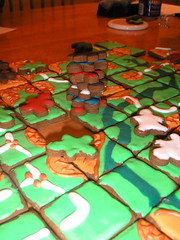
Gingerbread Carcassonne


PICT1000
Originally uploaded by zendonut.
In the grand tradition of Cupcake Catan, here is a Carcassonne game made from gingerbread.